

Mosquitoes and Climate Change
Guest authors: Angie Nakano, MS, Laboratory Director, and Rachel Curtis-Robles, PhD, Communications Director from San Mateo County Mosquito & Vector Control District
When you think about the possible effects of climate change, what comes to mind? Rising temperatures? Sea level rise? Atmospheric rivers? More extreme weather events?
Something that may not be at the top of your mind is the potential effect these changes could have on mosquitoes.
Mosquitoes 101
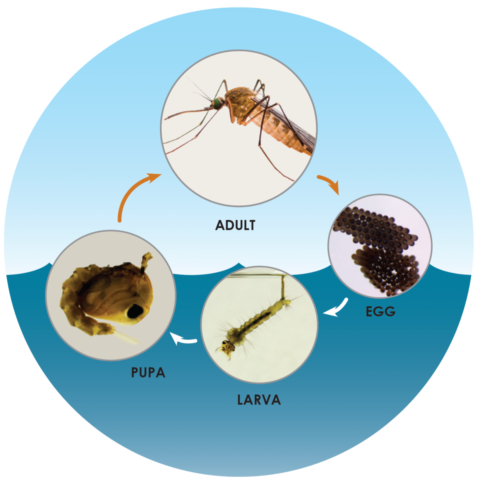
The mosquito life cycle depends on water – the eggs require water to hatch, and the larvae and pupae live in water. Only the adult mosquitoes live outside of water. This is why dumping standing water is a critical habit for you to prevent mosquitoes from growing in/around your home.
In San Mateo County, we have about 20 different species of mosquitoes. Each mosquito species has slightly different habits of where and when it is active, feeding, and laying eggs. (Sidenote – Did you know that only female mosquitoes bite? Male mosquitoes do not bite.) One thing they have in common is that higher temperatures speed up their development. Warmer temperatures mean that some mosquitoes can grow from egg to adult in just 7 days!
As the climate changes, there are many nuances to how these changes affect mosquitoes’ distribution, growth, and ability to spread diseases.
The Human Factor: How Humans Have Affected Mosquitoes
As people move from place to place, they may transport ‘hitchhiker’ mosquitoes in a few different ways…
Some mosquitoes lay their eggs floating on top of water, and those eggs (and the larvae and pupae that come from them) were likely how mosquitoes made their way from place to place in the times of ships moving people around. Did you know that Hawai’i did not have mosquitoes until whaling ships arrived in the early 1800s?
Other species of mosquitoes lay ‘sticky’ eggs on plants, planter pots, and other things that people are likely to move around. These eggs can stay dormant for months, or even years, waiting for enough water to hatch. As people move around – and move their stuff with them – this might be how some mosquitoes move to new locations. This is a particularly good way for invasive Aedes aegypti mosquitoes (which can spread dengue, Zika, and other diseases) to move around – they have been spreading throughout California since at least 2011. Explore the CDPH map for more information.
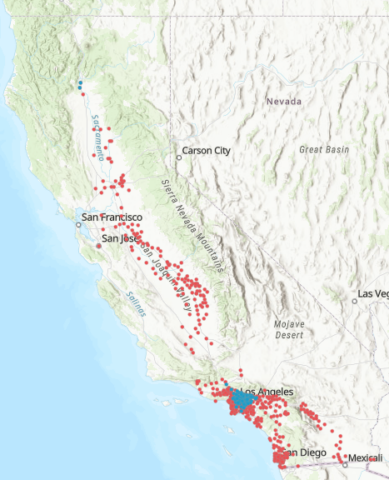
In many cases, mosquitoes accidentally moved to new locations probably die because they can’t survive in the local weather. However, with climate change, the risk increases that mosquitoes will survive (and maybe even thrive) after hitch-hiking to new locations.
How Temperature Changes Affect Mosquitoes
Rising temperatures can lead to changes in geographical distribution of animals, including mosquitoes…
Mosquitoes once considered “tropical” species might now find that areas further from the equator have become more comfortable for them. We’ve seen this in the steady northward movement of invasive mosquitoes like Aedes aegypti and Aedes albopictus in California. It’s not a foregone conclusion that increasing temperatures mean a mosquito species will survive in a new area – the conditions for mosquito population success are more complicated than just temperature alone – but it certainly lowers the barriers that kept these potentially disease-carrying species restricted to warmer areas.
Changes in temperature can also change the risk of disease transmission, as various vector-borne diseases have a higher risk of being passed on at different temperatures. This could lead to some areas seeing fewer cases of some diseases, while increasing the occurrence of others. (Check out recent Stanford work)
How Sea Level Rise Affects Mosquitoes
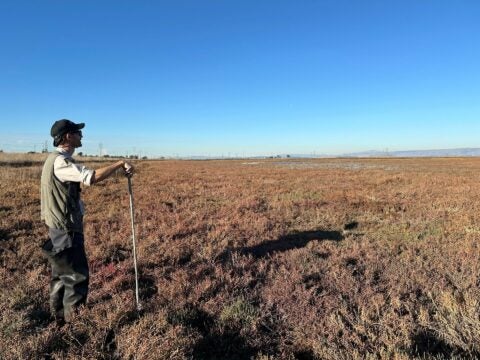
Sea level rise can lead to changes in where and which mosquitoes breed in different areas…
Along the eastern edge of San Mateo County, certain species of salt marsh mosquitoes (Aedes squamiger and Aedes dorsalis) lay their eggs stuck to marsh plants in the San Francisco Bay. Those eggs hatch into larvae when the water from high tides is trapped in low-lying areas of the marsh. While these mosquitoes rarely spread diseases, the adults are aggressive biters and can fly 20 miles to find people or animals to bite. They typically emerge in large swarms and are an unrelenting nuisance. These species of mosquitoes were the original reason for initial mosquito control efforts in San Mateo County.
As climate changes result in sea level rise, we know that “the king tides of today are the standard high tides of tomorrow” (Lori Lambertson, from the Exploratorium). Higher tide levels could mean a longer season for the emergence of salt marsh mosquitoes, or could lead to changes in shoreline ecosystems, permanently altering the balance of mosquitoes and mosquito predators in these areas.
How Extreme Weather Affects Mosquitoes
Extreme weather events such as atmospheric rivers and associated flooding can also trigger changes in mosquito populations…
As an example, from the Central Valley: Tulare Lake was once the largest freshwater lake west of the Mississippi River, but had been diverted for human use over the years. In years with intense rainfall, the Lake re-emerges. In 2023, the re-emergence of the Lake – caused by atmospheric rivers and a record melting snowpack – created habitat for millions of mosquitoes, many of which were Culex tarsalis, a main vector species for West Nile virus in California. This triggered a public health emergency declaration and over $6 million in disaster relief funds were spent on mosquito control.
Closer to home, along the Bay side of the County, many homes are built on land with a very high water table. High water tables and extreme rain events can result in standing water in crawlspaces. If water remains for a week or more, it creates a water source where mosquitoes can grow.
What is being done? And what can you do?
San Mateo County Mosquito & Vector Control District is an independent special district funded by tax dollars. District staff work to control mosquito populations – with a focus on those that bite humans and can spread disease – using integrated pest management (IPM) strategies. They trap mosquitoes as part of a regular surveillance program to understand baseline norms, and they work throughout the entire County to keep mosquito populations under control to protect public health.
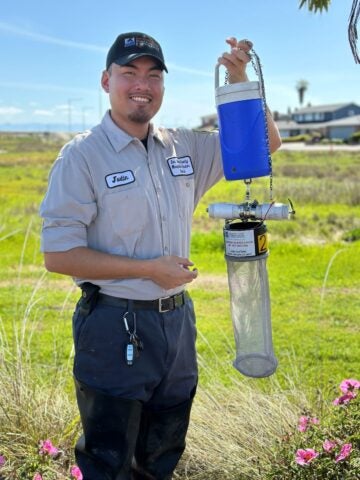
While District staff conduct plenty of work ‘behind the scenes,’ they need your help! You can reduce the chance of mosquitoes growing in and around your home with a few simple actions:
- Check around your property once each week to dump standing water. No need to waste the water – use it to water plants.
- Don’t overwater plants in planter pots with saucers. The extra water in the saucers can become a mosquito breeding location.
- If you save water in a rain barrel, be sure to check that the barrel is well-covered with a screen. This prevents female mosquitoes from laying eggs in the water. If your screen is broken or your barrel is not screened, consider covering it by stretching window screen fabric over the top of the barrel and securing with a metal band, bungee cord, or other tight-fitting closure.
- If your crawlspace is prone to flooding, consider contacting a plumber to add a sump pump. Be sure to learn about your sump pump – some turn on automatically, while others have a switch to turn on as needed. Be sure to check local city/county codes to understand where your sump pump outlet is allowed to drain.
- Report biting mosquitoes so District staff can visit to determine where the mosquitoes are coming from. District staff might set a trap to collect a few mosquitoes for identification. Identification of the mosquito species provides a key clue to the type of water source that produced the mosquitoes and can help staff more quickly determine the water source and control the mosquito larvae.
To learn more about pest management in San Mateo County, visit San Mateo County Mosquito and Vector Control District.
